Racallio Ryndoon
Fire & BloodRacallio Ryndoon was a Tyroshi captain-general, adventurer, and self-made king whose ambition repeatedly reshaped the struggle for the Stepstones. He first commanded the Triarchy’s forces against Daemon Targaryen, then claimed the islands for himself, and later negotiated with Alyn Velaryon when battle threatened to cost too much. His career joined military audacity to political betrayal; the strange, contradictory character described by the chronicles was also a ruler capable of keeping fierce personal loyalty among his men.
Identity and Reputation
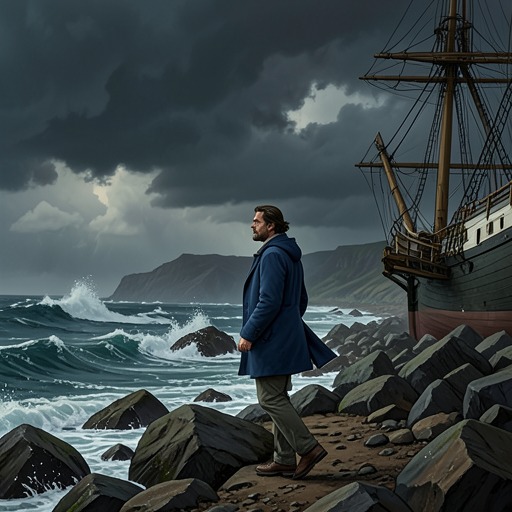
Little reliable information survives about Racallio’s youth, and the accounts of his origins conflict. He was reputed to stand six and a half feet tall, with one shoulder higher than the other and a rolling gait. His command of a dozen Valyrian dialects suggested high birth, while his notoriously foul language suggested a humbler origin. He dyed his hair and beard, favoring purple, sometimes streaked with orange, and was said to bathe in lavender or rosewater. These details, like much of his biography, belong to a portrait assembled from rumor as much as settled record.
The accounts agree more firmly on his appetites and contradictions. At leisure he was a glutton and a drunkard; in battle he was formidable, able to fight with either hand and sometimes with two swords. He honored gods of every kind, casting bones before battle to decide which god should receive a sacrifice. Though Tyrosh was a slave city, he hated slavery. When his fortunes allowed, he bought enslaved women and freed them. He shared plunder with his followers on terms no more generous to himself than to the least of them, and was also remembered for giving gold to beggars and readily handing over possessions that others admired. He loved kittens but hated cats, and was said to love pregnant women while loathing children. The chronicle calls him mad, yet emphasizes that his men loved and fought for him. His authority rested not only on force, but on a volatile generosity that bound followers to him.
From Triarchy Commander to King
Racallio first rose to prominence as the commander of the Triarchy’s renewed campaign in the Stepstones. Daemon Targaryen and Corlys Velaryon had gained control of nearly all the islands by 109 AC, and Daemon had declared himself King of the Stepstones and the Narrow Sea, with Corlys placing the crown on his head. That success proved fragile. The next year, the Kingdom of the Three Daughters sent a fresh invasion force under Racallio’s command, and Dorne joined the war in alliance with the Triarchy.
His later return to the islands came amid a wider crisis. After the murder of Sharako Lohar, rivalries among Tyrosh, Lys, and Myr erupted into open war. Tyrosh seized the opportunity to assert its power over the Stepstones, and its Archon called upon Racallio, a captain-general who had once fought Daemon there. Racallio rapidly overran the islands and put the reigning King of the Narrow Sea to death. He then claimed the dead king’s crown for himself, betraying both the Archon and his native city. The ensuing four-sided conflict closed the southern end of the narrow sea to trade, disrupting commerce between King’s Landing and eastern ports and drawing envoys from several Free Cities to seek an alliance against him.
For a time, the Archon’s title for him, Queen Racallio, became more than a taunt: by 133 AC, he held Bloodstone and the southern islands and stood at the height of his power. His first seizure of the islands and this later reign shared the same pattern. Racallio could serve a larger power, but would not remain subordinate when the prospect of a crown presented itself.
Rule, Alliances, and the Price of Passage
Racallio’s kingship did not make the Stepstones secure or unified. When Alyn Velaryon returned with a fleet, the island alliances had shifted again. Racallio held Bloodstone and the islands to the south, while Pentoshi sellswords serving the Archon of Tyrosh controlled rocks to the north and east. Booms and the wrecks of sunken ships blocked many channels; the passages still open were controlled by Racallio and his followers. Alyn judged that forcing a way through could cost him half his strength, which he would need for the war against the Red Kraken. Instead, he chose negotiation.
In 133 AC, Alyn detached Baela Targaryen from the fleet and sailed with her under a parley flag to Bloodstone to seek free passage. Racallio kept him for more than a fortnight in a sprawling wooden fortress. Whether Alyn was a captive or a guest remained unclear even to Alyn, an uncertainty that reflected the host’s mercurial conduct. One day Racallio welcomed him as a friend and brother-in-arms and urged him to join an attack on Tyrosh; another day he cast bones to determine whether he should kill him. He demanded that Alyn wrestle in a mud pit before jeering pirates. After executing a follower accused of spying for the Tyroshi, he gave Alyn the man’s head as a token of fellowship, only to accuse Alyn himself of serving the Archon the next day.
To establish his innocence, Alyn was forced to kill three Tyroshi prisoners. Racallio was delighted by his response, but the episode shows the danger beneath the performance of fellowship: welcome, suspicion, and tests of loyalty could follow one another without warning. Racallio’s demand for passage was similarly theatrical and transactional. He asked for three ships, an alliance written on sheepskin and signed in blood, and a kiss. Alyn gave him the fleet’s three least seaworthy ships, an alliance on parchment signed in a maester’s ink, and the promise that Baela would kiss Racallio if he visited Driftmark. That compromise satisfied him, and the Velaryon fleet passed through the Stepstones.
Defeat and Narrative Significance
The Daughters’ War eventually ended with Racallio’s flight to the Basilisk Isles alongside his remaining supporters. Lys, Tyrosh, and Myr divided the Disputed Lands, while Dorne took dominion over most of the Stepstones. The settlement favored the Archon of Tyrosh and the Dornish, and left Racallio displaced from the island kingdom he had claimed. The record does not describe his later fate beyond that retreat.
Racallio’s place in the account is shaped by the gap between the scale of his reputation and the limits of his rule. In the Free Cities, his life inspired scholarly studies, songs, poems, and romances; in Tyrosh, respectable people reviled him, while people on the margins revered him. His story presents power as both a contest of fleets and a contest of personal allegiance: he could seize islands, redirect trade, and command devoted fighters, but his reign depended on unstable alliances and could be undone by forces larger than his own. Even his passage bargain with Alyn compresses that character into a political encounter—dangerous, extravagant, and finally settled by an exchange in which neither side gave quite what Racallio had demanded.